Thread Lift forFace & Body
Gravity works on tissue the same way it works on everything else — slowly, and in one direction. Over the years, cheeks, brows, the jawline, and the neck all drift downward as the support structures beneath them lose their hold. Volume fillers can plump these areas back out, but they cannot reposition tissue that has already descended. A thread lift can do both at once.
Fine dissolvable threads — typically composed of PLA and PCL, sometimes coated with hyaluronic acid and other collagen-stimulating compounds — are threaded beneath the skin using a slim needle or cannula. Depending on their shape, some threads simply anchor and hold tissue in a lifted position, while smoother variants work purely to stimulate collagen production. As the threads gradually dissolve over the following months, the fresh collagen matrix they leave behind continues to provide support long after the material itself is gone.
The outcome is a firmer, better-defined contour that can last up to two years, achieved entirely without incisions, general anaesthesia, or surgical downtime. Thread type, insertion depth, and the angle of placement are all planned around each individual's own facial anatomy and the specific change being sought.
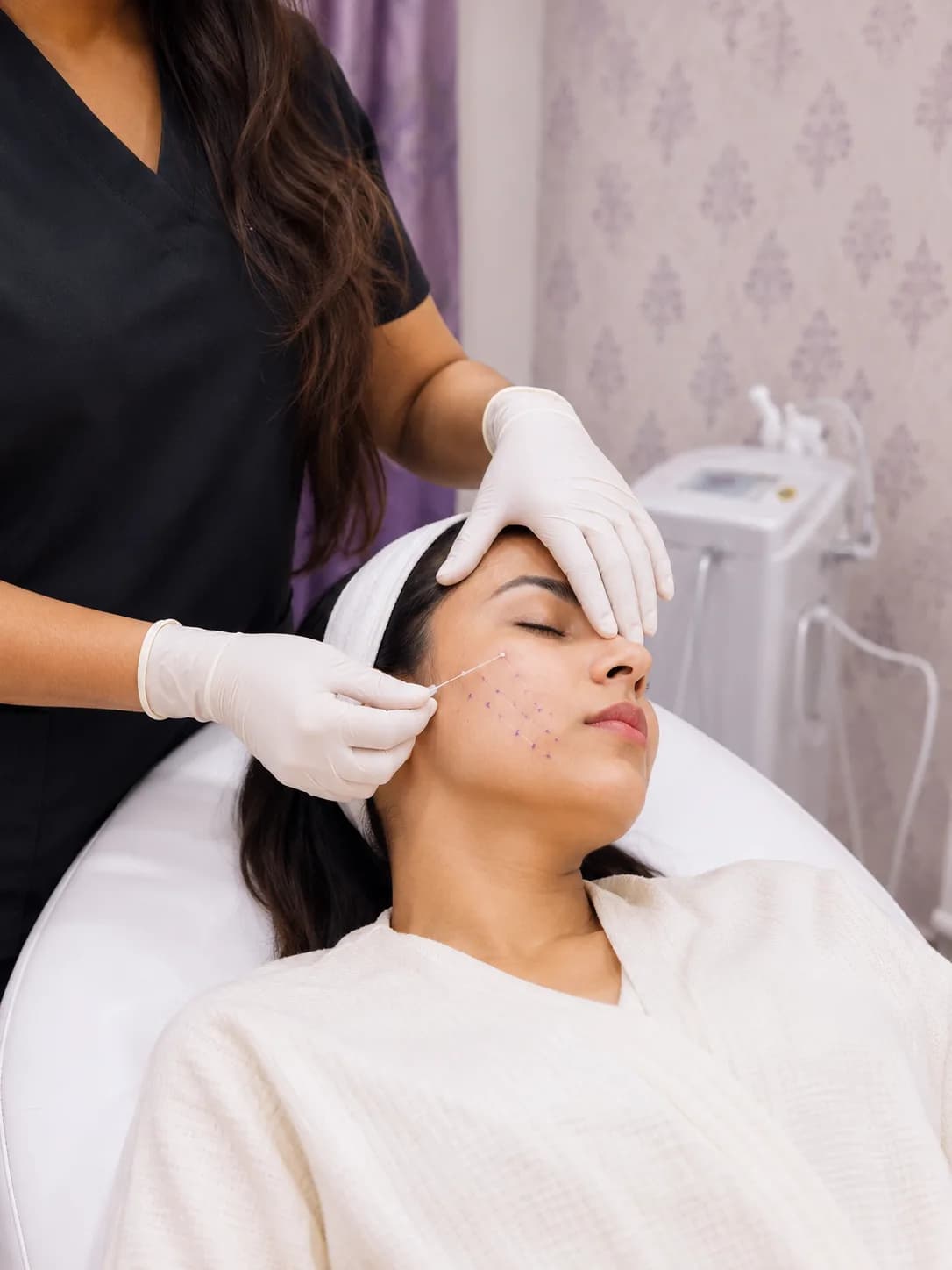
A non-invasive treatment for sagging jowls, midface descent, brow drop, and neck laxity — performed across face, neck & body in just 60–90 minutes, ideally every 12–18 months.
* Treatment times are approximate and vary based on individual skin needs.
Top Benefits ofThread Lift Treatment
Thread Lift repositions tissue that has already dropped, giving an immediate lift alongside a slower collagen-driven improvement — all without a single incision.
Steps of Thread Lift Treatment
A carefully planned, minimally invasive procedure that lifts and holds descended tissue in place. Here is what to expect from your appointment.
Structural Assessment
Your specialist examines how far tissue has descended, evaluates skin quality, and plans out the specific lift vectors your face calls for — no two treatment maps are identical.
Numbing
A topical anaesthetic is applied and given time to take full effect; local anaesthetic may also be used at entry points for extra comfort.
Entry Points
Small entry points are created with a fine needle along the planned vectors, preparing the path for thread placement.
Thread Placement
A cannula carries each thread along its vector and deploys it beneath the skin, where it is tensioned to achieve the intended lift. This is repeated across every planned line.
Contour Shaping
Once threads are in place, your specialist gently shapes the overlying skin and checks the result with you seated upright, where gravity shows the true effect.
Aftercare Guidance
Mild swelling, bruising, or a pulling sensation at entry points is normal for about a week. Your specialist advises on activity limits and may prescribe mild pain relief to ease recovery.
How Does a Thread Lift Work?
Thread Lift combines two distinct effects — mechanical repositioning and collagen stimulation — that together produce both an immediate and a lasting result.
Dissolvable Thread Material
PLA and PCL threads are fully absorbed by the body over roughly three to six months, leaving no permanent implant behind.
Barbed & Cogged Threads
Small barbs along the thread grip surrounding tissue, allowing it to be mechanically repositioned and held in place.
Smooth Collagen-Stimulating Threads
Used purely to trigger fresh collagen production, improving skin quality without a mechanical lift.
Cannula-Based Insertion
A blunt-tipped cannula reduces trauma and bruising compared to sharper insertion tools.
Immediate Visible Lift
The repositioning effect is visible from the moment threads are tensioned, while the collagen benefit continues to build afterward.
Face & Body Application
Used across jowls, midface, brow, neck, abdomen, and inner thighs depending on the concern being addressed.
Frequently AskedQuestions
Can't find what you're looking for? Our team is happy to answer your specific questions directly.
Book Your Consultation Today
Take the first step towards healthier skin and confident beauty.
